When planning a trip to Indonesia, one of the first decisions you face is whether to apply for the e-VOA (electronic Visa on Arrival) or simply buy a traditional VOA (Visa on Arrival) at the airport. While both visas offer the same 30-day stay and cost the same amount, the differences between them can significantly impact your travel experience.
This guide breaks down every difference between the e-VOA and VOA so you can choose the right option for your trip.
What is the VOA (Visa on Arrival)?
The Visa on Arrival is the traditional method of obtaining your Indonesian visa. You purchase it at the immigration counter when you land at an Indonesian international airport or seaport. It costs IDR 500,000 (approximately USD 30) and grants a 30-day stay.
The VOA has been available since 2004 and remains the default option for travelers who do not apply online before their trip.
What is the e-VOA (Electronic Visa on Arrival)?
The e-VOA is the digital version of the VOA. Launched in November 2022, it allows you to apply for and receive your visa entirely online before you travel. You arrive in Indonesia with your visa already approved, skip the payment queue, and proceed directly to immigration.
Both the e-VOA and VOA are classified as B1 Visitor Visas.
Side-by-Side Comparison
| Feature | e-VOA | VOA |
|---|---|---|
| Application method | Online (before travel) | At the airport (upon arrival) |
| Cost | IDR 500,000 (~USD 30) | IDR 500,000 (~USD 30) |
| Initial stay | 30 days | 30 days |
| Extension | Up to 60 days total | Up to 60 days total |
| Extension method | Online or immigration office | Immigration office only (3 visits) |
| Entry type | Single entry | Single entry |
| Eligible countries | 97 countries | 97 countries |
| Queue at airport | Skip VOA payment queue | Must queue to pay |
| E-gate eligible | Yes (with biometric passport) | No |
| Processing time | Minutes to 5 business days | Instant (at the counter) |
| Advance preparation | Required (apply before travel) | None needed |
The 5 Key Differences
1. Airport Experience — Skip the Queue
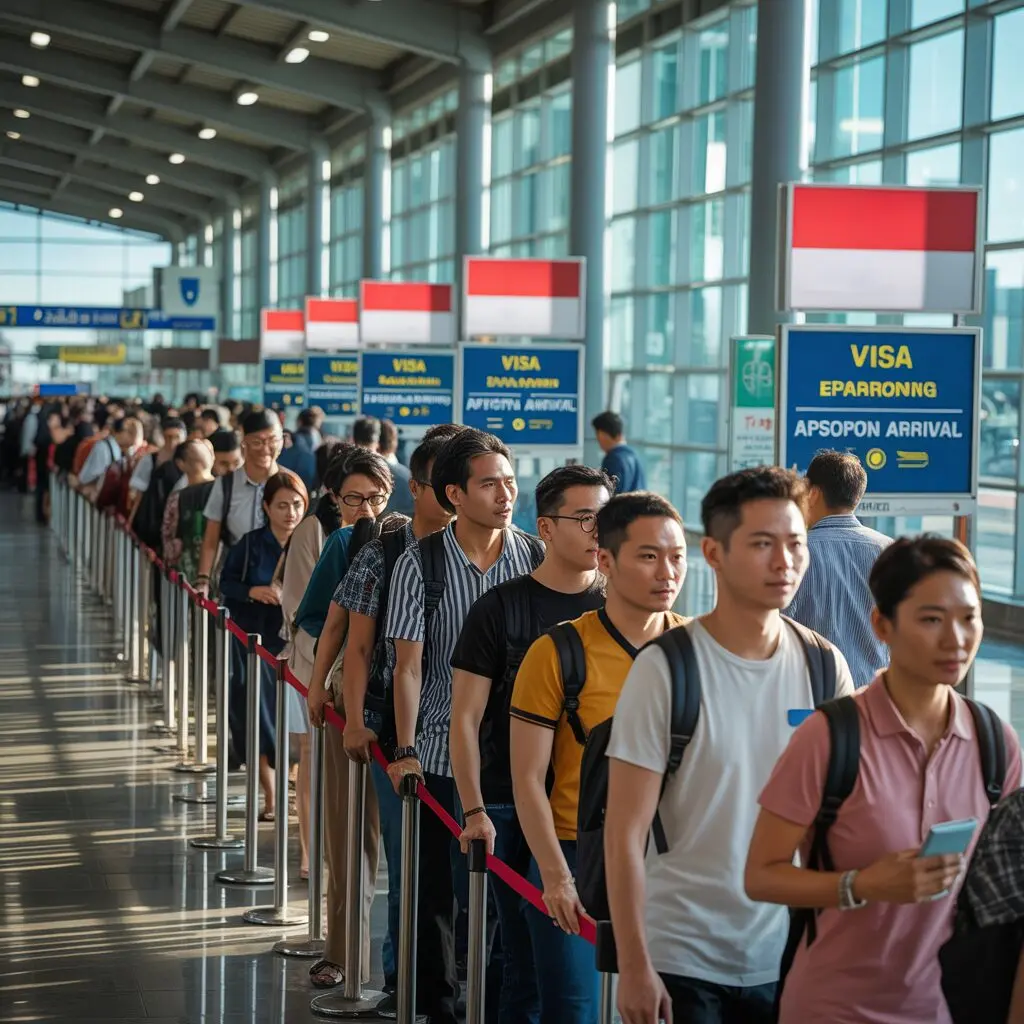
This is the most immediately noticeable difference. When you arrive at a busy Indonesian airport like Bali’s Ngurah Rai (DPS), the VOA payment counter can have long queues — sometimes 30 minutes to over an hour during peak arrival times.
With an e-VOA, you walk past the payment counter entirely and go straight to the immigration officer. For travelers arriving after a long international flight, this can save significant time and frustration.
During peak seasons (July-August, December-January, and major Indonesian holidays), VOA queues at Bali airport can be particularly lengthy.
2. Extension Process — Easier with e-VOA
This is where the difference becomes most significant, especially if you plan to stay between 30 and 60 days.
Extending a regular VOA:
- You must visit a local immigration office in person
- The process requires 3 separate visits:
- Each visit can take several hours
- Many travelers hire an agent (costing IDR 500,000-1,500,000 on top of the visa fee) to handle the paperwork, but you still must attend the biometrics session in person
1. Apply and schedule a biometrics appointment
2. Photo and fingerprinting session
3. Pick up your extended visa
Extending an e-VOA:
- Apply online through the same portal (evisa.imigrasi.go.id)
- Pay the extension fee online
- In some cases, you may still need to visit an immigration office for biometrics
- The process is significantly simpler and faster
For travelers planning a 30-60 day stay, the e-VOA’s easier extension process is a compelling advantage.
3. E-Gate Access
At select Indonesian airports (including Bali), biometric passport holders with an e-VOA can use the automated e-gates. This means:
- No waiting in the manual immigration queue
- Faster entry process
- Automated passport verification
VOA holders cannot use e-gates and must go through the manual immigration counter.
4. Advance Preparation vs Spontaneity
The e-VOA requires you to apply and receive approval before your trip. This means:
- Planning ahead (at least a few days before departure)
- Having your documents ready digitally
- Checking your email for the approved visa
The VOA requires no advance preparation — you simply show up and pay at the airport. This makes the VOA better for:
- Last-minute trips
- Travelers who are unsure of their exact arrival date
- Spontaneous travel plans
However, the e-VOA validity period is 90 days from issuance, giving you a generous window for your travel dates.
5. Payment Convenience
e-VOA: Pay online with a credit or debit card before you travel. You know the exact cost upfront and can budget accordingly.
VOA: Pay at the airport counter in Indonesian Rupiah (IDR) or by card. Some travelers report card payment issues at the airport. Having the exact amount in cash (IDR 500,000) can speed up the process, but you need to obtain IDR before or upon arrival.
Which Should You Choose?
Choose the e-VOA if you:
- Want to skip airport queues
- Plan to stay 30-60 days (easier extension)
- Want to use e-gates (with biometric passport)
- Prefer to have your visa sorted before departure
- Are arriving during peak travel season
- Want to avoid currency exchange hassles at the airport
- Travel with family (apply for up to 5 people at once)
Choose the VOA if you:
- Are making a last-minute trip with no time to apply online
- Prefer a simple, pay-at-arrival process
- Are only staying a few days and do not need an extension
- Do not have a credit or debit card for online payment
Do Not Confuse These with Other Visa Types
Both the e-VOA and VOA are B1 Visitor Visas limited to 30 days (extendable to 60). They should not be confused with:
- B211A Visit Visa: For longer stays (60 days, extendable up to 180 days). Requires more documentation and costs IDR 1,500,000+.
- Visa Exemption: Available only for ASEAN nationals. 30 days, not extendable, free of charge.
- Limited Stay Permit (KITAS): For work, study, or long-term residence. Requires sponsorship.
The e-VOA is the Recommended Choice
For most travelers, the e-VOA is the better option. The ability to skip airport queues alone makes it worthwhile, and the significantly easier extension process is a major advantage for longer stays.
The only scenario where the traditional VOA makes more sense is for truly spontaneous travel where you do not have a few days to apply online before departure.
Frequently Asked Questions
Is the e-VOA more expensive than the VOA?
No. Both cost exactly the same: IDR 500,000. The e-VOA may incur a small credit card processing fee (around USD 1-3), but the base visa fee is identical.
Can I switch from a VOA to an e-VOA after arriving?
No. Once you enter Indonesia on a VOA, you cannot convert it to an e-VOA. You can extend the VOA at an immigration office, but the process is more involved than extending an e-VOA.
Can I use the e-VOA at any Indonesian airport?
Yes. The e-VOA is accepted at all Indonesian international airports and seaports, including Bali, Jakarta, Surabaya, Medan, Yogyakarta, and others.
Does the e-VOA allow me to stay longer than the VOA?
No. Both allow a maximum stay of 60 days (30 days initial + 30 days extension). The difference is in how easy the extension process is, not the maximum duration.
What if I arrive without a VOA or e-VOA?
You will be denied entry. Citizens of non-ASEAN countries must have either a VOA, e-VOA, or other valid visa to enter Indonesia.